Venerable Knights,
I am half-way through the dev cycle towards the next version, and this time things will get ultra-exciting: for one, that version will be the official demo, available for free to everyone, which means a lot of new players will get their hands on the game. What's more, this might just be the biggest update yet, and I cannot wait to hear what you think about the long list of new features and improvements.
We had a few thousand players registering for the Playtest. Feedback was fantastic and included many improvement suggestions. While not every suggestion can become reality, many of them did meet the criteria, which are: (1) will the change make the game more fun, (2) does it fit to the overall vision, and (3) are effort and benefit in a healthy relation?
Feedback becomes reality
Inventory stacking was the #1 request in the Playtest - this QoL feature has become quite common in modern RPGs and is somewhat expected. It is now implemented and will keep your inventory organized, while also massively increasing the number of items you can take along.
Another popular request was allowing multiple saves. Adding the ability to keep several saves for one game session was something many players felt strongly about. Since the game auto-saves whenever the map changes, there was little player-control over the saving process in the Playtest, and it was not possible to keep "checkpoints" of game progress. This limitation was by design, but when it became clear that the design is not popular, I changed it. It is now possible to store multiple saves for a game.
Since I was already re-designing the saving/loading process, I added quicksave/quickload functions, too.
Along with those changes I also implemented the separation of data between saved games, which increases the loading performance and makes things more robust.
Balancing has improved in many ways. The top issue here was that the chapter 1 quest was too difficult in the Playtest, simply because it was not possible to enter the town of Borderton near the quest destination. When you arrived at the site, your resources were already depleted, and there was no way to replenish before entering the challenging quest dungeon. The town of Borderton can now be entered and explored, and stores, priest services, and of course a tavern eagerly await your business. Now you can take on those ruins fully healed and stocked up.
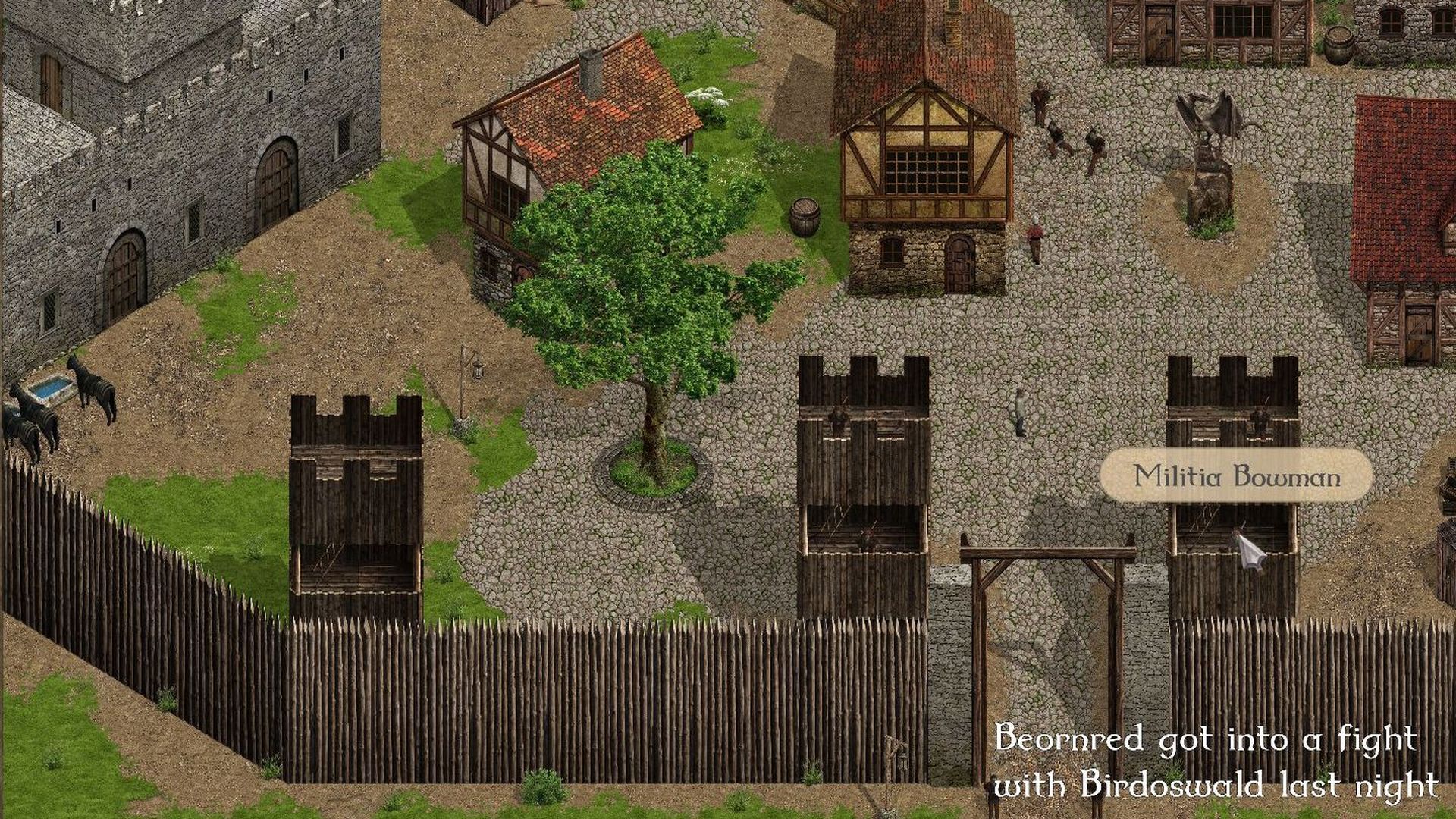 Being close to enemy territory, Borderton's palisade wall offers critically needed protection
But the game's balancing has improved in more ways, and the experience has become generally more forgiving. For instance, the attribute penalty for dying is now a thing of the past - it was harsh to start with, but more importantly, with distinct saves in place, it did not make sense to keep it around.
For those who prefer a harder challenge, ironman mode continues to be an option, but it is no longer the default. In ironman mode, distinct saves are not available - dead means dead.
Some Playtesters were also not happy about the fact that the tutorial quest "Aldhelm's Path" was mandatory. Starting off in prison, where the mechanics are quite different from the rest of the game, wasn't everyone's cup of tea. Neither was the fact that the tutorial character is pre-made... a fixed character is not unusual for a tutorial, but playing through this standalone tutorial adventure takes about two hours, which was more time than some testers were willing to spend on something they found too limited. So in an effort to not scare off players who might really like the regular game, I made "Aldhelm's Path" optional, but I still strongly recommend playing it first (it is also really fun).
A common point of feeback around tactical combat was that many enemies would run away too often... this was intentional and meant to be realistic (living things tend to like their lives), but it often ended in annoying chases and little loot, which felt unrewarding. It might have been more realistic, but it surely wasn't more fun. While many NPCs will still run away if the odds turn against them, they will not run away quite so quickly anymore. Plus, leg injuries will now slow them down significantly, so going after those injured escapees often will not take long (mind though, this also applies to the player character, so there's a new angle to escaping from combat).
Many new features and improvements
Aside from those player requests, there are other new features and tons of new content. I am only listing things here that have already been completed, so expect more at the time of release.
One new feature is an item's quality rating. Manmade items including weapons, armor, and much more, can now be of "poor", "regular", or "excellent" craftsmanship. If you are lucky, you might even stumble upon a rare "masterpiece". The quality rating affects many of the item's properties - which ones, depends on the exact item, but could include a weapons damage, the protection offered by a piece of armor, clothing temperature bonus, price, and other.
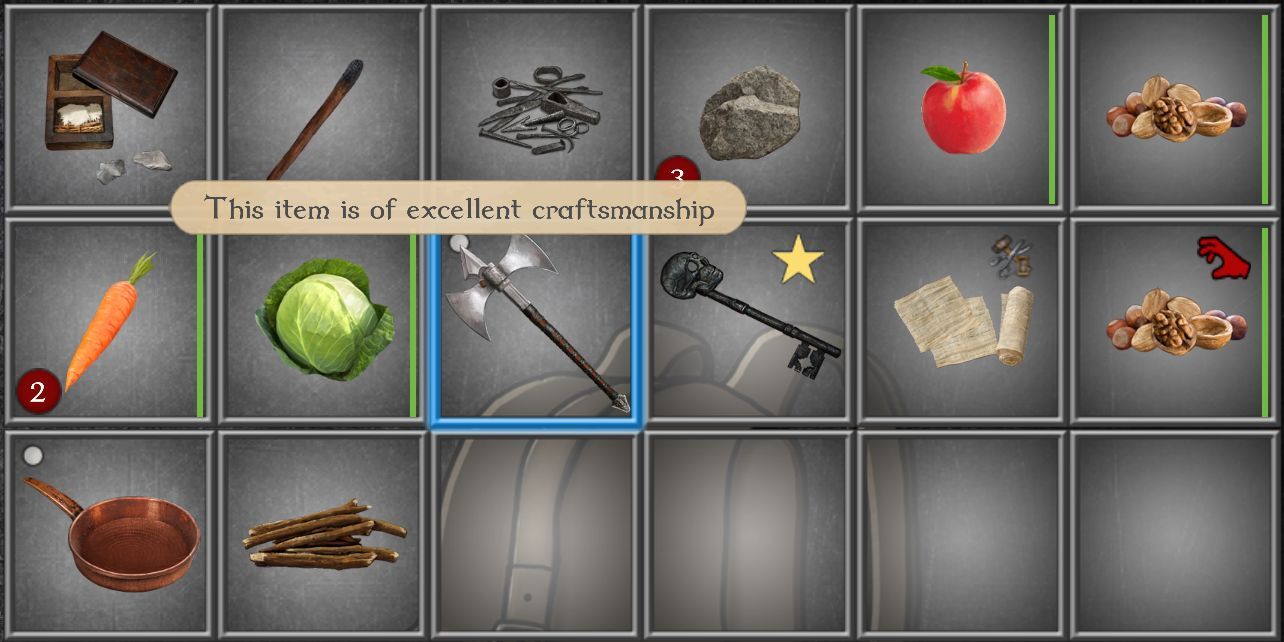 The inventory has been extended to support item stacking, and items can have a quality rating now
In the Playtest, you were able to set up two different equipment sets to store your preferred equipment for melee combat, ranged combat, while in town, or any other imaginable use. This has been extended to three equipment sets.
The new chapter 3 quest, allowing you to advance by one more character level than previously, will take you to the town of Minton. Just like the town of Borderton mentioned above, Minton had been on the world map in the Playtest already but could not be entered. This is no longer the case, so there are two new towns in the game to explore now.
(Adding a new town is a major effort... I thought some folks might be interested in this process, so I will go into more detail about it below.)
The chapter 3 quest not only adds a new town though... it also adds a new type of dungeon. I am planning to add even more dungeons to the demo, but one of them is already finished.
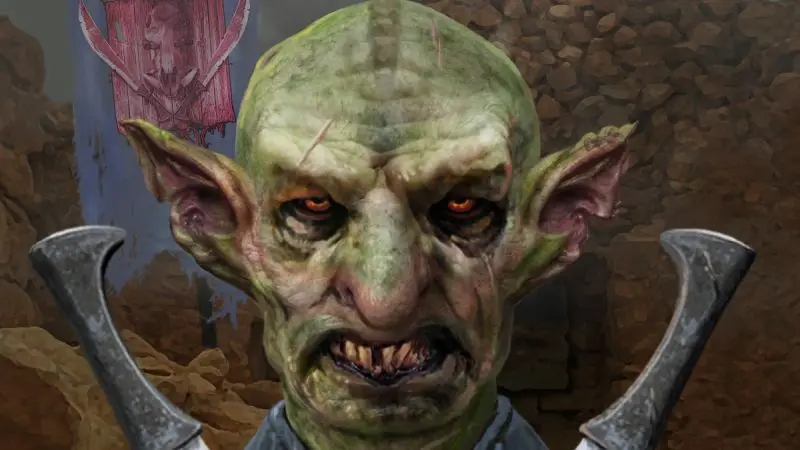
The new places also contain new characters. Aside from entirely new types, including some undead, animals, and... hm... "other", there are dozens of new unique townsfolk NPCs, each with individual behavior, conversation topics, portrait, and so on.
Towns also contain many new buildings and other objects, such as new types of trees.
I could go on for a little while, but I'd like to keep some surprise and delight for the release, so I'll stop here and will take you through the process of adding a new town to the game. But not before quickly mentioning that 34 leftover bugs from the Playtest have also been fixed.
Building cities
Maybe you remember the 1996 title "Daggerfall" which contained many more towns than one could possibly ever visit. However, they were all procedurally created and did not differ much from one another. Here, it was about quantity, not quality. Don't get me wrong, I absolutely loved Daggerfall (which is, BTW, available for free in its original version and also as a modern remake), but the design around towns in Knights of Frontier Valley is meant to be different. In this game, there is a much smaller number of places, but they are all meaningful and feel differently.
Here is my process for adding a new town to the game:
1) Design the town's general concept
What is its background story, where should it be placed on the world map, and who lives there?
2) Add the town to the world map
To show the town on the world map, map art with seasonal variants is needed. The world map generator needs to be extended to include placing the town procedurally and connecting it to the road network.
3) Integrate new types of buildings
For each new type of building added to the game, map art is needed in seasonal variants. Details about the building like its indoor layout, the time-driven change of window illumination, and particle effects for chimney smoke and flame effects like an outside smithy forge need to be defined.
There are two types of buildings: explorable ones, including residential houses or taverns, and special ones such as stores, churches, or guard quarters.
For the explorable ones, logic to procedurally create indoor maps has to be added.
For the special buildings, a unique image is shown instead of a map when entering. Each town's general store, for example, looks differently inside and requires new art. Each store is also run by a unique character, for who a portrait, animations, and conversation topics need to be created.
For shops, the store inventory needs to be defined: which items are being sold or purchased here?
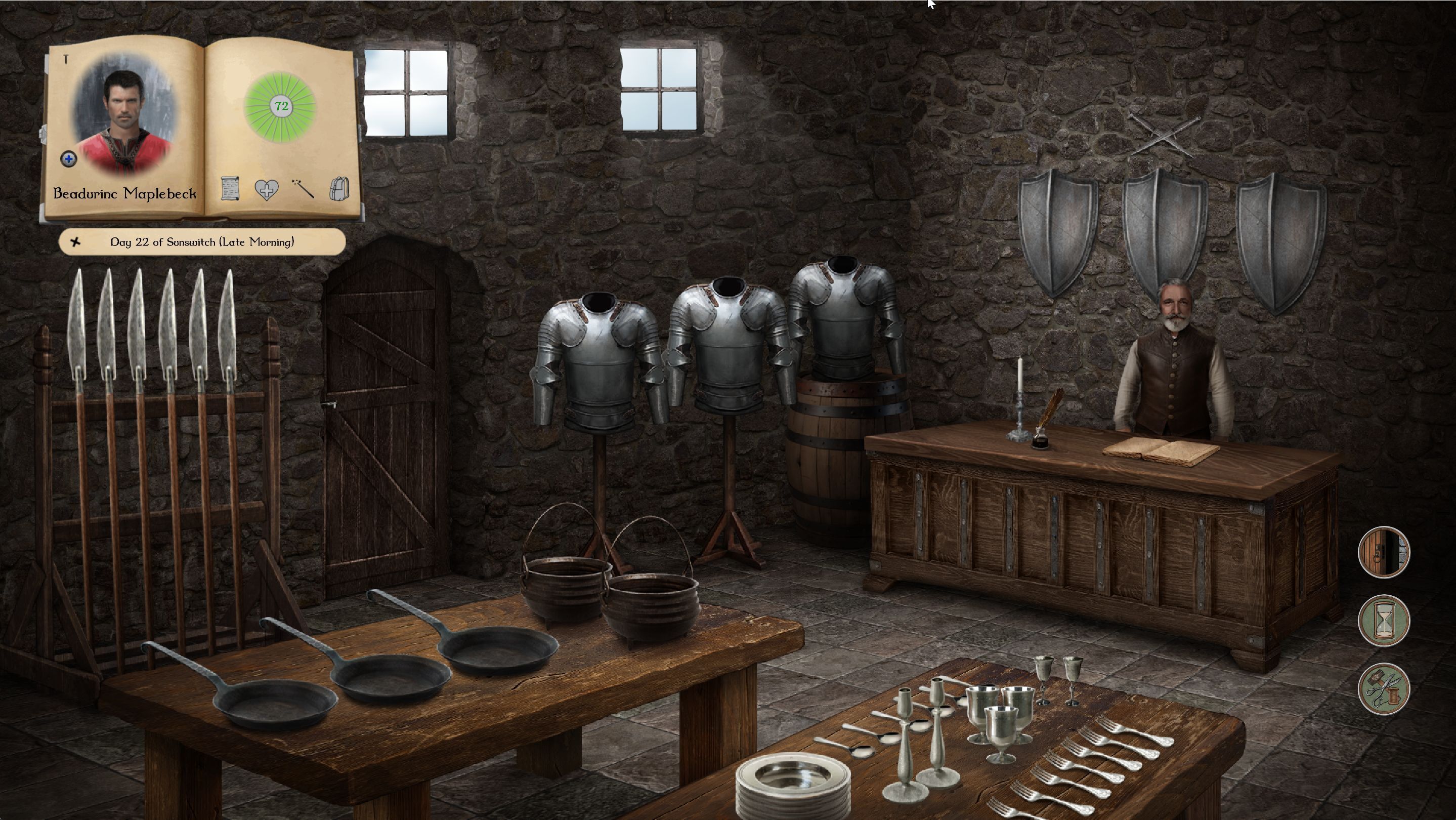 The Minton Metalworks specializes in forged items of supreme craftsmanship
4) Create the town's map
Town and tavern maps are the only maps in the game that are not procedurally generated. The town map is created using a visual editor which works a lot like a city builder game and is really fun to use. Any of the new builings added above need to be included in the editor so they can be placed, which is a bit of coding effort.
It usually takes a few days to create a new town map from scratch. The greatest challenge here is adding an enclosing defensive barrier like a city wall or fence around the settlement. Connecting wall segments and towers is not something the editor supports, so it has to be done manually. This is a laborsome process requiring pixel-accurate placement, or else there will be a gap in the wall or an error in the rendering order.
5) Define settlement areas
All towns contain several distinct areas like the marketplace, residential areas, or the area around a special building like a cathedral or palace. While walking through town, an image of that area is shown in the ambient panel.
The boundaries of those areas have to be defined and their art be added. That art is seasonal, so multiple variants are needed. The image is also dynamic and requires additional layers that are shown based on context... illuminated windows are only shown at dusk, items being sold at the market only when the market is open, and so on.
6) Add the town's population
A good part of a town's population is made up from normal citizens with professions like candlemakers, fletchers, ropemakers, builders, and dozens more. There are also domestic animals.
Then there are unique characters like store owners or priests.
The remaining inhabitants depend on the specifics of the town... there might be miners, woodcutters, soldiers or other characters present, depending on what the town is about.
When setting up the population, it needs to be ensured that the number of people matches the available houses.
7) Define town-specific NPC positions and routes
In Knights of Frontier Valley you can see vendors walk to their stalls at the marketplace in the morning, and present their wares throughout the day while they walk around near their stalls occasionally. Those vendor positions need to be defined.
Then guard patrol routes need to be set up - a patrol route should cover most of the town's area and lead past all street lanterns, so patrol guards can turn them on or off based on daylight conditions.
8) Create the tavern map
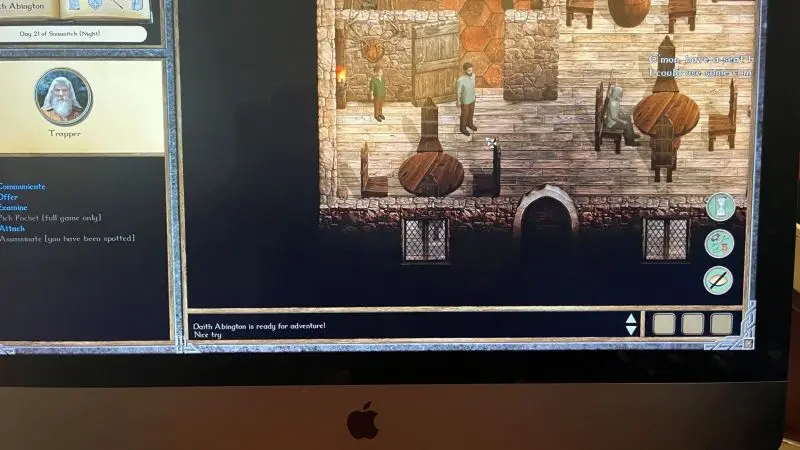
What would a fantasy town be without a tavern? It is a unique building, and the map for each level is made with an indoor map editor. This step is my favorite!
9) Fill the tavern with life
Tavern services like available rooms and the food offered need to be defined. Any place the waitress should visit, like tables or areas in the kitchen, also need to be set up. Lastly, conversations between the waitress and tavern guests need to be scripted.
10) Add anything else town-specific
All towns have some unique mechanic to them. The large city of Thyle, for example, consists of four city quarters, each with its own map. When players change quarters, a large "supermap" of the entire city is shown - this mechanic is only used in that one town.
Minton, as another example, is a mining town. The mines (technically a dungeon) need their own map, and some of the townsfolk, the miners, needs to be programmed to go in there for work. Something like this is not done anywhere else and requires new game code.
11) Music
Each town comes with its own background music. All music is specifically made by professional composers to fit the town... the track for Minton, for example, contains smithing sounds like a hammer falling on an anvil and the hissing sound of a hot-red sword dipped into water. Some towns have several music tracks, as it is expected that the player will spend more time there, calling for more variety.
All taverns have their own music track as well.
12) Testing
When all this is done, everything needs to be tested and then the town is ready to appear in the game!
Until next time,
Martin